The Blood of American Soldiers: “A Small Price,” Says GOP Leader

TPM grabbed this from CNN, and C&L reposted the video. This isn’t some minor guy speaking. This is the leader of the Republicans in the House of Representatives, John Boehner, telling us how he really feels about the very soldiers his ilk are constantly instructing us to "support:"*

Here’s the transcript — Boehner is quite pointedly asked not just about the financial cost, but about "the loss in blood, the Americans who are killed every month."

BLITZER: How much longer will U.S. taxpayers have to shell out $2 billion a week or $3 billion a week as some now are suggesting the cost is going to endure? The loss in blood, the Americans who are killed every month, how much longer do you think this commitment, this military commitment is going to require?

BOEHNER: I think General Petraeus outlined it pretty clearly. We’re making success. We need to firm up those successes. We need to continue our effort here because, Wolf, long term, the investment that we’re making today will be a small price if we’re able to stop al Qaeda here, if we’re able to stabilize the Middle East, it’s not only going to be a small price for the near future, but think about the future for our kids and their kids.

I suppose maybe Boehner may claim that he wasn’t paying attention to the second part of the question, that all he heard were the dollar figures. That would be simply restating the problem. Rather precisely.

There are so many other falsehoods packed into that one brief response that it’s almost like one of those Highlights for Children puzzles where you have to find two dozen things hidden in a cartoon tree. No, we’re not "making success." No, General Petraeus didn’t really outline anything "pretty clearly;" the Pentagon itself reportedly disagrees with a great deal of the what was ultimately just a rehash of longstanding Bush administration talking points. No, the war isn’t going to "stop Al-Qaeda" (which isn’t centered in Iraq, of course, had no connection to Saddam before the war, but which now uses the war itself as a major recruiting tool). No, we’re not going to unilaterally "stabilize the Middle East," no matter what happens in Iraq. And so on. How many ways can the GOP House Minority Leader disconnect from reality in one paragraph? Find ’em all!

And the blood of American soldiers, not to mention countless Iraqi civilians, continuing to be spilled so allow this nonsense can continue? It’s "a small price."

* "Support," remember, means "allow to die and be maimed in large number for no clearly attainable objective other than preventing a massive loss of face for the war’s supporters."

UCLA/NYU Study: “Conservative” and “Liberal” Brains May Simply Function Differently

Apparently it’s not just a "set of beliefs" — it may simply be who we are:

Previous psychological studies have found that conservatives tend to be more structured and persistent in their judgments whereas liberals are more open to new experiences. The latest study found those traits are not confined to political situations but also influence everyday decisions.

[snip]

Analyzing the data, Sulloway said liberals were 4.9 times as likely as conservatives to show activity in the brain circuits that deal with conflicts, and 2.2 times as likely to score in the top half of the distribution for accuracy.

[however]

Lead author David Amodio, an assistant professor of psychology at New York University, cautioned that the study looked at a narrow range of human behavior and that it would be a mistake to conclude that one political orientation was better. The tendency of conservatives to block distracting information could be a good thing depending on the situation, he said.

Trying to step outside ideology (if that’s possible), and leaving aside the loaded words "liberal" and "conservative" for a bit, maybe I’m missing something, but if studies like this keep coming up with the same results, this information may have important practical implications. You need to land a damaged plane, deliver a baby under stress, win a battle on the ground, etc.? A brain that simply does not process distractions, alternatives, and conflicting information might be much better at it. You need to make long-term plans and decisions in a complex and constantly changing world uncharacterizable by singular notions? The all-the-options brains might fare better.

Otherwise, you get policy driven by ideology.  And we all see just how peaceful a world that makes.

Sample ImageWhat leapt out most while working on Who Hates Whom is the symmetrical thinking of reactionaries — we’re completely in the right, the other side consists of lesser beings who do not see the truth and must bend to it and become like us, yadda yadda yadda — leading both sides of many (certainly not all) conflicts. This is of course a lot less troubling to look at in faraway conflicts than one you’re more directly involved in, which is part of what I hope will make the book useful. (Still, you enjoy feeling troubled, Jon makes a bit of a hobby out of finding disturbing parallels between our own unsavory leaders and others. Rainy day fun!) Over and over, extremism — which is, after all, merely a heightened inability to consider alternatives — fuels its counterpart on the opposing side, often to the detriment of all.

In short: Barry Goldwater once said, "extremism in defense of liberty is no vice." Maybe not, but it’s frequently a direct contradiction in terms.

Not that we aren’t all getting a daily lab course in this, if we care to notice.

And of course, the idea that how your brain processes information should somehow largely determine the course of your life (which, of course, it does) in any way other than the sort of self-selecting manner that already exists may run counter to everything a free thinker holds dear. So maybe there’s no valid application for the UCLA/NYU findings after all.

Worth thinking about, though.

Rugby World Cup 2007: Separated at Birth?

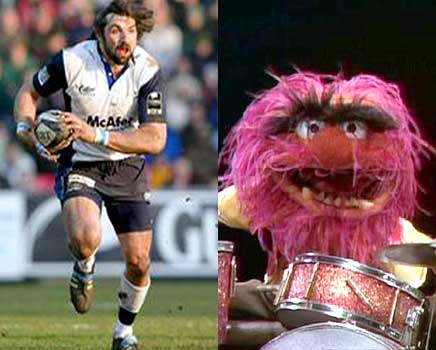
Watching France v. Argentina in the opening match the other night, I couldn’t help but think I’d seen French second-rower Sébastien Chabal somewhere before.

Sample Image

Oh. Right.

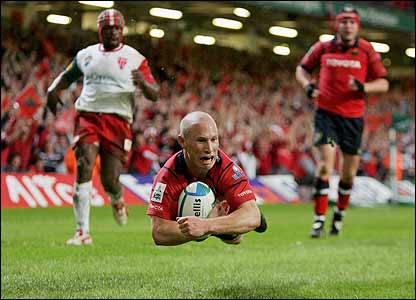
Then again, I still say Munster scrum half Peter Stringer is really Bat Boy from the Weekly World News.

Sample ImageSample Image

Incidentally, if you missed New Zealand v. Italy or Australia v. Japan, you can re-enact the lopsided results by taking a bag of rugby balls the edge of Niagara Falls and throwing them over, one by one.

Each ball is a Kiwi or Aussie possession, and the air resistance on the way down is the Japanese or Italian defense. When the ball hits the river below, count that as a score for New Zealand or Oz.

Each time the ball bounces all the way back up the falls and lands in your hands, give five points to Italy or Japan. Then toss that ball directly back over the edge.

When you run out of rugby balls, add up the score.

Friday pudublogging: PUDUBALL! Game on!

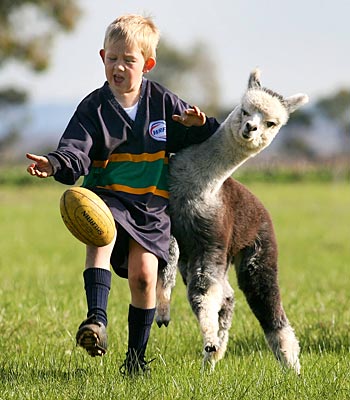
Unbelievable week of sport ahead, personally, given the teams I cheer for. Whatever sport you look at — even Aussie Rules footy played with alpacas — it’s PUDUBALL on! 

Sample Image

Baseball is in its stretch run, and the Indians are 11-1 since the very day they figured out what to do with their batting order. They’ve also found a damn nice second baseman and second hitter in Cabrera. And they’re even in town this weekend.

The NFL begins its season this week, and the Browns will suck less this year. That’s no small thing.

The Rugby World Cup kicks in France, despite a last-minute media boycott. The host team will surprise, I think. But I’m picking New Zealand over the Boks in the final.

Aussie Rules enters its postseason, with my two favorite teams, the Swans and Weagles, both in good form. (Yes, I normally back Sydney teams, but a close buddy from Perth is now living in the US, and he’s an unhealthy influence.)

Even the Arses are kicking arses, despite losing Thierry Henry to Barcelona this year. Not playing this weekend, though, and thank goodness. My DVR would explode.

Oh — and the cricket Twenty20 World Cup starts in Johannesburg on Tuesday. (Go Oz! Like there’s any doubt.)

I could plotz. It’s like a big sweaty harmonic convergence or something. It’ll be weeks before I ever catch up with it all, but hey. Small world, too much fun here.

PS — almost forgot: Australia’s popular NRL starts its postseason this weekend, too. (Btw, NRL team names are to die for. Who wouldn’t cheer for the Parramatta Eels, the South Sydney Rabbitohs, or the Manly Sea Eagles?) Thing is, I don’t have a huge allegiance to any of these cross-country wrestling teams yet. I’ve watched a couple of Gold Coast games, curious to see how Mat Rogers from the Waratahs makes the transition to league, and I generally cheer for the Roosters, since I have happy memories of Aussie Stadium. Eh. Guess I’ll cheer for the upstart Rabbitohs this week, despite Russell Crowe’s looming presence and an offense which seems lately to consist of punching people in the face.  Somehow "Go ‘Tohs" should have more of a ring, though.

Our Tiny President

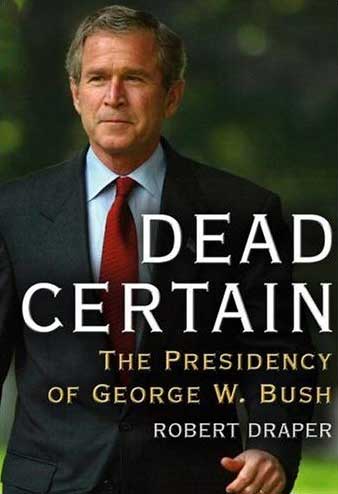
If you didn’t catch this in the NY Times over the weekend, author Robert Draper recently received unprecedented access to Bush, six full hours of private interviews. In the Times’ preview of Dead Certain, Draper’s resulting book, Bush displays the depth of his genuine desire to improve the lot of humanity.

Sample ImageWill Bush work to improve global conditions of hunger, homelessness, and military tension, like certain other ex-presidents you could name? Um… no:

First, Mr. Bush said, “I’ll give some speeches, just to replenish the ol’ coffers.” With assets that have been estimated as high as nearly $21 million, Mr. Bush added, “I don’t know what my dad gets — it’s more than 50-75” thousand dollars a speech, and “Clinton’s making a lot of money.”

Then he said, “We’ll have a nice place in Dallas,” where he will be running what he called “a fantastic Freedom Institute” promoting democracy around the world. But he added, “I can just envision getting in the car, getting bored, going down to the ranch.”

Small enough? There’s more. Asked about the disbanding of the Iraqi army, one of the key mistakes of 2003, Bush took no responsibility for even knowing what had happened:

Mr. Bush acknowledged one major failing of the early occupation of Iraq when he said of disbanding the Saddam Hussein-era military, “The policy was to keep the army intact; didn’t happen.”

But when Mr. Draper pointed out that Mr. Bush’s former Iraq administrator, L. Paul Bremer III, had gone ahead and forced the army’s dissolution and then asked Mr. Bush how he reacted to that, Mr. Bush said, “Yeah, I can’t remember, I’m sure I said, ‘This is the policy, what happened?’ ” But, he added, “Again, Hadley’s got notes on all of this stuff,” referring to Stephen J. Hadley, his national security adviser.

Yeah, well, that catastrophic decision that helped create the lasting insurgency… I dunno, one of my guys has some files…

The rest will be in Draper’s book Dead Certain, released today.