The trip continues. As always, I’ve squeezed in more to do and see (except sleep and actually write anything) than any sane person would, resulting in a million notes and little analysis, even more so than on the round-the-world thing. Still, some stuff I gotta share, even if completely out of context, just for coolness and I hope your vicarious enjoyment. Top of the head…
Coolest thing to do on a lark: head up to Olympia, find the original stone starting line, and sprint 200 meters in 95-degree heat in street clothes with nobody around, giggling like a little kid.
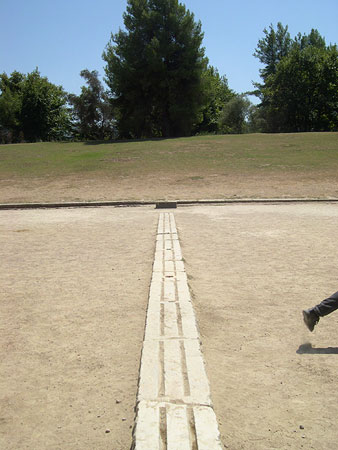
Also a stupid thing to do, in retrospect. But fun… still, if I start acting like I’m having insights here, remember, it could just be the fried brain cells talking.
I’m writing this from the island of Rhodes, now a part of Greece, located just off the Turkish coast in the southeastern end of the Aegean. That’s Rhodes as in The Colossus Of, which used to be about 200 yards from where I’m sitting, at the entrance to the harbor.
Backstory: Alexander the Great’s conquering army eventually got tired, sick, and partly dead while walking home from India (and really, have you ever walked home from India?), and even Ali G. himself died in Babylon. Soon, his successors had a big hassle over who got which piece of the known world.
The folks in Rhodes sided with Ptolemy. This made one of his rivals, Antigonus, severely antagonized. So he sent an army to invade Rhodes and kill everybody here, but the plucky Rhodians survived long enough for Ptolemy to send in the cavalry (sort of — actually, it was a naval fleet, this being an island and all).
Thrilled to be not dead, the Rhodians decided to build a statue to Helios, the sun god and their main guy, using leftover war crap conveniently left behind by the retreating army. This is my favorite bit of recycling in history.
So up went Helios, probably wearing a spiked crown and holding a torch, and about the same size as our modern Statue of Liberty. So mentally stick one of those here, and you’ve got most of the picture.
(Common portrayals of Helios standing astride the harbor, with ships suggestively passing just under his groin, are fun to look at but thoroughly insane, by the way. Standing right here, you can see that construction would have blocked the harbor — and thus the island’s entire economy — for years. The Rhodians were ancient, not stupid. No, most historians agree that the statue was just pretty much the standard Greek guy-standing-there deal, albeit a really big one.)
The Colossus stood for 56 years, then fell in an earthquake, leaving pieces of Helios strewn about in the water — shinbone here, thumb sticking out over there — for the next thousand years. (This is a good time to mentally reference Charlton Heston at the end of Planet Of The Apes.)
Finally, some Arab invaders grabbed the metal for scrap. More recycling.
Which means this particular wonder was fascinating trash about 20 times longer than it was anything useful. This seems the standard life cycle for products of hubris.
The spot is now marked with twin pedestals bearing not-so-colossal deer, which are the modern emblem of the island.
As a lifelong fan of various relatively tiny adorable ungulates, this makes me extremely happy.
Nearby, you find the walled city built by the Knights of St. John, an order of monastic warriors who ruled this joint for a while, in between various bursts of Persians, Greeks, Arabs, and assorted Turks. (Incidentally, the order’s modern version has reportedly counted among its members, if memory serves, William Casey, Allen Dulles, and Augusto Pinochet. I mention this for no reason other than it’s fun to have in your head, and you might just grow a tinfoil hat.)
Inside the walled city, you find the Mosque of Suleiman the Magnificent, medieval architecture in unparalleled condition, and maybe a hundred kiosks selling modern disposable tourist crap of the first order.
There’s also a cool vertical rectangle that took me a full minute to study before I finally realized it was a sundial with Arabic markings. Neat.
What to make of all this, other than glee?
It’s one thing to read it all in books, but being here I’m getting a much more profound sense of just how many grand civilizations before our own have thrived briefly, fallen, and been completely forgotten, even though they were completely certain that their gods were real, their customs were the highest evolution of human development, and their future was necessary for the very destiny of life on earth.
Now we barely even remember their names.
Of course, this time it’s different…
We’ve got a whole planet in serious trouble from global warming, well-armed religious fanaticism, WMD proliferation into countries which, unlike Iraq, actually have them, and a dozen other things of unprecedented scale. And every great civilization which didn’t actively address its problems has fallen as surely as Helios.
I turned on CNN in my hotel today, the first time I’ve seen it on the trip. They said absolutely nothing of any importance, really urgently, for about ten minutes.
Man, if there’s one thing I’m learning: human beings are really good at simply "solving" their problems by killing each other with complete certainty that it’s the will of God, using us in a divine struggle to project our own egos onto the world, against all evidence in the whole of human experience.
It’s actually funny, the whole pageant, when you look at it on a time line. What a bunch of maroons we are.
Which is a lot more fun than I’m making it sound. Honest.
One other thing I’ve learned:
If you get to the island of Hydra, when the old woman standing at the dock offers you a donkey, don’t say no.
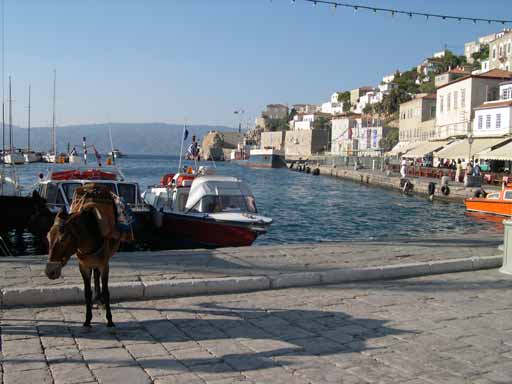
Give her some money, finally figure out how to ride a donkey about halfway up the hill, and enjoy the view.
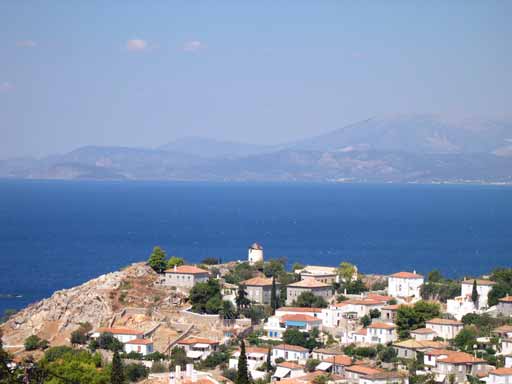
Headed to Turkey next. I’m gonna have to start writing books about all this stuff I’m seeing. Didn’t even touch my notes, which are huge, and the pictures are beyond wild. Gotta find a publisher one of these days…