I’m in a fantasy baseball league. I am a geek. Shocking, I realize.
I’ve never won. But his year, I’m trying a new strategy: trying to win by making all the other teams better, too, one by one. Strangely, it seems to work.
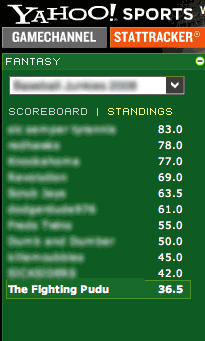 Here’s the deal: by early May, my team (“The Fighting Pudu”) was already struggling in last place. I’d had a bunch of injuries, plus I’d drafted both Victor Martinez and Troy Tulowitzki, possibly this year’s two most impressive flops. It already looked like winning would be a longshot.
And then came an epiphany.
Trades in this game tend to be infrequent, partly because people can be reluctant to give up players of value, and partly because people sometimes ask for a little more than they’re giving up. Basic stuff. Nothing surprising there.
But if you’re in a league with ten other teams (which I am), and you make ten trades, one with each team, each of which benefits both parties equally, win-win — totally fair transactions, where you give up some major all-star the other guy needs, in exchange for some good player at a different position that you want, so both teams get better — that’s essential — eventually, you’re probably going to win.
The math is thuddingly obvious: in the hypothetical example, your team improves ten times; if other people aren’t trading generously, everybody else’s team improves just once. Eventually, the team with ten improvements will rise — precisely by finding ways to make everyone else better.
The outcome seems so inevitable (at least in this closed system) that I think you can actually afford deals more advantageous to the other guy, over and over and over — as long as your own team keeps improving, little by little, and you keep rotating partners.
It’s like a strange Zen arithmetic of cumulative generosity.
This thought had philosophical appeal, so I’ve been pursuing it ever since, just to see what happens. So far I’ve managed to ship off Chipper Jones, Edinson Volquez, Manny Ramirez, David Ortiz, and Matt Holliday — five All-Stars, including last year’s NL MVP.
That’s no way to win, is it? But the Pudu started charging up the standings immediately.
(In exchange, I got Joe Mauer, Alfonso Soriano, John Lackey, Johan Santana, and Prince Fielder, if you’re curious. There were a few thrown-ins each way, but both teams benefitted in every deal.)
At the moment, pretty much half my team is on the trading block — and the Pudu have been in first place for weeks now, by a margin that just keeps getting bigger.
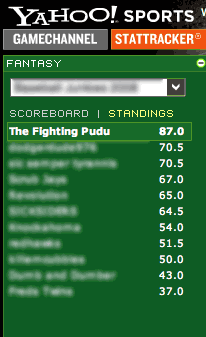
I’m sure there are other factors involved, too, of course. And maybe I’ve just suddenly lucked out for months. Maybe I’ll be in last place again by fall. But dang, so far, the logic is holding up.
Weird, huh? Make everyone else better, and you win. But the math seems obvious, once you get it. Then it almost feels like they should teach it in Sunday school. (Although it’s so self-interested it almost feels more like business school.)
The best thought: this would have worked whether or not I’d understood the math. Being friendly and interested in what everyone else needs would be rewarded — inevitably, as a function of very simple arithmetic — even if you had no idea how.
I wonder how often we find ourselves in other situations like this and we never realize it. Maybe a lot.
Maybe even some big ones.
That’s pretty wonderful to think about.
As to the Fighting Pudu, I’m no longer worried about a particular roster spot or injury; now I’m just worried about the other players getting wise to the tactic and trying to out-nice each other, all at once.
But that would be pretty cool, too.