Who Wants to Be a Millionaire? My Friend Lyn, That’s Who

If you’ve read Prisoner of Trebekistan, Lyn Payne is:

(a) the fellow contestant upon whose shoulder I put my head when I survived the first round of the 1998 Jeopardy! Tournament of Champions while suffering from a lousy fever,

(b) the fierce competitor who pushed me into the "Compleat Angler" Final Jeopardy moment in the semis,

(c) a real sweetheart, and

(d) going to be on Millionaire tomorrow (and possibly, I think, the next day if she does well).

I hope she won the whole giant kaboodle.  Will be watching.  Go Lyn!
Next Up: the Australian Dollar

Sample ImageThe Australian dollar sat around US $0.75 the last couple of times I was down there.

I peeked back over the summer, and it was sitting around US $0.83.

Today I glance down, and it’s at US $0.92. That’s a big move — over 10 percent, just in the last few months.

If current trends continue (and thanks to enormous trade and budget deficits, they probably will), it may not be long before the Canadian dollar is joined by the Australian dollar in passing parity in its US exchange rate.

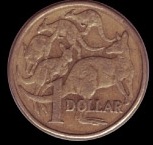
At least this one has kangaroos on it. Five of them, in fact. So, bouncy, at least.

Last year, Princeton economist and NY Times columnist Paul Krugman notably suggested that the dollar would eventually suffer a "Wile E. Coyote moment," when dollar holders would suddenly notice they’d long ago run over the cliff and hadn’t had anything under their feet in some time.

Here’s a recent amplification on that, including a brief look at theories as to what’s keeping the coyote in the air, by one of Krugman’s colleagues, the head of Europe’s Centre for Economic Policy Research.

Yikes.  Don’t look down, I guess.

Next Up: the Australian Dollar

Sample ImageThe Australian dollar sat around US $0.75 the last couple of times I was down there.

I peeked back over the summer, and it was sitting around US $0.83.

Today I glance down, and it’s at US $0.92. That’s a big move — over 10 percent, just in the last few months.

If current trends continue (and thanks to enormous trade and budget deficits, they probably will), it may not be long before the Canadian dollar is joined by the Australian dollar in passing parity in its US exchange rate.

At least this one has kangaroos on it. Five of them, in fact. So, bouncy, at least.

Last year, Princeton economist and NY Times columnist Paul Krugman notably suggested that the dollar would eventually suffer a "Wile E. Coyote moment," when dollar holders would suddenly notice they’d long ago run over the cliff and hadn’t had anything under their feet in some time.

Here’s a recent amplification on that, including a brief look at theories as to what’s keeping the coyote in the air, by one of Krugman’s colleagues, the head of Europe’s Centre for Economic Policy Research.

Yikes.  Don’t look down, I guess.

My Life As a Talking Head

Just came back from the live talking head gig on CNN’s Reliable Sources, chatting about the wildfires. (Additional supporting links have been added below; scroll down or click here.)

Pretty much exactly what I expected: six or seven minutes of dearly wishing that every damn thing wasn’t so frequently framed as partisan, and wishing I wasn’t contributing to it.

As I said (or tried to, anyway) on the show, science itself should be in no way partisan, and both Republican and Democratic lives and livelihoods will all clearly be in greater danger for years to come. This should never have been framed this way. Maybe if I’d been asked on in some other format or framework. I dunno. But man, nobody giving aid and shelter and food down at Qualcomm this week asked for party affiliation. Democratic and Republican firefighters work together side by side without a thought. Politicizing a huge and growing future problem this way so debases our ability to solve it together.

But how do you plead for bipartisanship when (a) you’re already tagged before you speak as being the lefty voice, and (b) the current administration, which is Republican, is actively censoring science? Just pointing out objective reality looks partisan in that context.

Still, I went on because the science on climate change and its relation to wildfires is much clearer than I think most of the media has reported (see some of the links below for starters), and I wanted to get the information out there. Southern California is my home. I care about this greatly.

I don’t naturally like to talk over people or be talked over, but the format almost demands it. The time limitations force you into this weird haiku of talking points, pushing each side to try to score points rather than just talk. Plus, even in normal conversation people often need a couple of shots at getting what they mean into words, so in this compressed environment, someone will almost inevitably say something inaccurate. (I know I did at least once, not meaning to.) So I suddenly found myself talking over the other guest a couple of times even though I was trying not to, and probably vice versa. And amid the babble I have no idea if anyone gained any useful information. I kinda doubt it.

Frankly, that there are people who actually enjoy this process baffles me. I have no idea what sort of emotional worlds professional pundits must inhabit. But I don’t think I’ve ever even visited.

I’m also saddened to notice that even people on "my" side of things were evaluating the appearance not just in terms of how much information I got out, but also in how I looked to them in comparison to the other guest, which is so dearly not the real point. (btw, I’m sure she’s quite bright, kind, and good-willed. Sincerely, I mean that. Most people are pretty wonderful, given a chance. Not fully grokking the various ecosystems in California and how they are managed differently is perfectly understandable. At a party, we probably would have had a great time, disagreed, chatted amiably, found common ground, and moved on. Instead, I kinda had to confront her in a way that would be rude in any other context, and I feel lousy about it. This does not come naturally to me.)

What I regret not saying most of all: that those chairs should be filled with real scientists and experts with direct knowledge and experience, not bloggers, including me, for gods’ sake.

Then again, TV is a business, and they have airtime to fill. Y’know, it never really occurred to me before how much the 24/7 news cycle may itself have contributed to the fracturing of America and this tragic partisanship now so pervasive that it’s frequently mistaken for patriotism on both sides. (I’m guilty of that myself a hundred times over, btw.)

Our visual window on world events is constantly being filled with this left/right thing, imposed even when it doesn’t belong. It’s great, inexpensive, entertaining TV. But we now have an entire generation of people who don’t even remember a time when extreme partisanship wasn’t a frequently televised, culturally acceptable, mainstreamed part of our discourse.

How we ever turn back from this I have no idea.

Some Useful Wildfire Links

No idea what’s going to come up exactly on CNN this morning, but for viewers who bop over here after, these might be useful links:

Forest-fire Warnings Cut From Testimony (CDC would have testified linking global warming and wildfires)

Apparent full version of CDC testimony (leaked by someone in the CDC)

San Diego Declaration on Climate Change and Fire Management

US Forest Service: Climatic Change, Wildfire, and Conservation

CBS News: Warming Climate Fuels Mega-Fires

Science Magazine: Warming and Earlier Spring Increase Western US Forest Fire Activity (fire season has lengthened by up to two months; what this means: yes, it snows in Buffalo — but if it snowed in Buffalo in August, we’d grasp that something has changed)

Science Daily: Massive California Fires Consistent With Climate Change

US Forest Service Appeals Archive (see for yourself if appeals are really holding up fuel reduction measures in California chaparral — the answer: at least not for the last ten years)

San Diego fire chief quit for lack of requested manpower and equipment

Gotta run. If something else comes up — which it probably will — and I should post a link, I’ll do it within a couple of hours of the show.

Thanks for stopping by.

(Added later:)

SF Chronicle: State National Guard Warns It’s Stretched to the Limit (Head of California National Guard says in May that needed equipment is in Iraq, elsewhere, or unfunded; in the same article, Gov. Schwarzenegger concurs that "equipment has gone to Iraq, and it doesn’t come back")

USA Today survey of National Guard equipment as of four months ago (California was rated at "50%" and reported to be short 800 Humvees, 700 tactical vehicles, and 50 heavy lifter trucks, although the spokesman maintained the state was still prepared)

Map of and photos of California chaparral (notice the distinct difference between chaparral and, for example, pine forest)

LA County Fire Dept. page on chaparral management (local ongoing activity simply not appealed by environmentalists)

United States Geological Survey brief (explains that in chaparral and coastal scrub, "catastrophic wildfires are not the result of unnatural fuel accumulation," limiting the value of prescription burning anyway)

LA Times: Forest Thinning Helps Spare Some Homes (true enough — but note that the area under discussion is Lake Arrowhead, whose 5100-ft. altitude is more comparable to Denver than San Diego, with a markedly different ecosystem including large stands of resin-laden pine, requiring different management)

Press-Enterprise: Speed Forest Thinning to Ease Fire Threat, Experts Say (again, the discussion here concerns Big Bear, a pine-rich mountain area at 6700 feet; the story explicitly links wildfires and the buildup of dead-tree fuel in part to climate change, beginning with "the nation’s worsening fire seasons are, in part, a consequence of global warming…")