As you’ve probably already heard, about 100,000 of our fellow humans marched in peaceful opposition to a brutal regime yesterday, led by maybe 1000 Buddhist monks in full-on saffron gear waving six-color religious flags.

Burma may seem far away, but it’s not. Significant oil reserves, for example. Changes here, if nothing else, could affect how much you pay at the gas pump down the road. Also, it’s ruled by a thuggish dictatorship opposed by most of its own population, and we all care about that on principle, right? So, big story. Theoretically.
Obviously, we’ll root for the guys in burnt sienna togs holding pics of the Nobel Peace laureate, but nobody knows what happens next.
Thing is, for those relying only on TV news, nobody knows what already happened, either.
Out of curiosity, tonight I taped an hour each of two of CNN’s signature shows — the "Situation Room" (where the main situation usually seems to be Wolf Blitzer needing to speak in headlines! every third word!) and "Prime News with Erica Hill" on CNN’s Headline News channel. So just how much airtime did an unprecedented march against one of the world’s most despicable governments get?
Prime News with Erica Hill: zero minutes and zero seconds.
To anyone mistakenly relying on this program, the vast protest in Burma simply didn’t happen. Although there was time to mention Mike Tyson’s latest arrest, possible criminal charges against Britney Spears, a tapestry in Florida that kinda looks like the Virgin Mary, and — I kid you not — an extended discussion entitled "Does God Watch Sports?" Speaks for itself.
The Situation Room with Howlin’ Wolf: one minute, fifty-two seconds, total, including a pre-commercial tease.
After a half-hour of designated-enemy baiting (Ahmadinejad’s impotent idiocy contrasted with the speaking styles of Castro, Chavez, and Khruschev) and pointless yet heavily-hyped chat with Donald Trump (why? because he’s so terribly hard to find on TV?) — and only after reporting on a new study finding that (quoting CNN’s graphic) "Too Much, Not Enough Sleep Can Kill You" — one brief report on Burma, almost completely devoid of history or context.
Wolf tossed to a young lady named Abbi standing at a big TV showing a QuickTime movie downloaded from the internet, which she proceeded to point at, confirming that these were indeed monks in "MEE-ann-mar," and this was footage from the internet, and the Burmese government doesn’t like it. Back to you, Wolf!
(Think I’m exaggerating? Read the transcript.)
So. Aren’t you still a little curious about why tens of thousands of Burmese might join this monk-led protest? Or just how oppressive the Burmese government might be? Who exactly is this Nobel Peace Prize winner Aung San Suu Kyi, now in her twelfth year of house arrest? And how is she descended from a key luminary in Burma’s independence struggle, and therefore inseparable with national identity for many democracy activists? Why is it called Myanmar by some people and Burma by others? What’s the difference? Where the hell is Burma, anyway, and why did the British and Japanese fight over it? What about the influence of China, and its oil companies, and those of other countries? Is it still a big source of opium? And what’s the deal with boycotting teak? Are we still supposed to do that?
That’s all in the Burma essay in Who Hates Whom. And it’s only five pages long. Including a map showing roughly where the major oil pipelines and opium producers are.
Who Hates Whom exists because today’s pattern was no exception. It’ll be repeated elsewhere tomorrow, and the next day, and the next. The sad reality: TV news shows generally are not there to deliver you information that you can use — they exist to deliver you… to the advertisers. You’re the product being bought and sold. And the most efficient way to do that is to inflame, to excite, to bring back recurring characters (Donald Trump, coming up next!), good guys and bad guys. It’s a news show, involving actual news, to about the same extent that Cheez Whiz involves actual cheese.
(If you need further proof, why else would a perfectly intelligent CNN anchor bother to conduct a lengthy segment rambling on about whether or not an unknowable infinite invisible deity is personally invested in televised sports, for f*** sake? It sure as hell ain’t for the news value.)
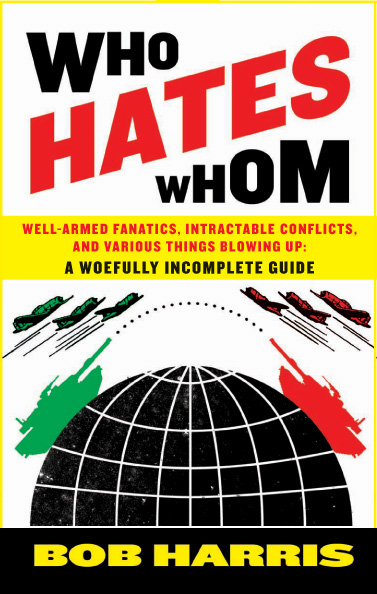 So last year, I was in my editor’s office, and we were bouncing around ideas for my next book. Not intending to pitch this, actually, I made one offhand comment about how it would be cool if there were a little guidebook, called, I dunno, Who Hates Whom or something, detailing most of the major conflicts in the world with little maps and photos and short essays, all crunched down short enough that you could bone up on Iran or Sudan in one trip to the can. Next time tens of thousands of people are pouring into the streets, or something blows up somewhere and you’re, y’know, a little curious what the hell is going on, and you’d like something that doesn’t involve Britney Spears being shot by Phil Spector, this book would be handy.
A year later, Who Hates Whom hits bookstores today. It ain’t perfect, mind you — wars are high-flux situations, books require months of lead time, and I’m neither infallible nor a real expert on anything — but it’s the best I could squeeze together, small enough to fit in your jacket pocket.
Meanwhile, let’s just hope that the Burma chapter in some future edition will have a very happy update. Instead of the messier one that the government decided on last time.
 I am so happy and proud to know this guy.