The excised chapter on Fiji and its never-ending coups will go here.
Great rugby in Fiji, btw. Big fan of William Ryder, even though he can’t play defense worth a flying, er, Fijian.
The excised chapter on Fiji and its never-ending coups will go here.
Great rugby in Fiji, btw. Big fan of William Ryder, even though he can’t play defense worth a flying, er, Fijian.
The extra chapter on Peru, not included in the book, will appear here.
Fujimori actually just said that getting extradited was always part of his plan. Yeah. Right.
Nothing here — and in fact, none of the book — should be taken as authoritative. It’s just my best shot at summing up everything I can and cramming it into as few entertaining words as possible. This book just seemed like it should exist, so now it does.
Finally, I’ll point out my own amusing hypocrisy. The US media get criticism for not covering the conflict more — in a section I was forced to cut from the book myself. Hrmph.
Senegal, The Gambia, "Senegambia," and Casamance
This space will remain under construction for a while; notes, updates, errata, and stuff I wished I’d been able to include in the book should all eventually wind up here.
Introduction/Foreword Thingy
• The Treaty of Kadesh is located in the Istanbul Archaeological Museum. Go if you get the chance.
• CNN, Fox News, MSNBC, ABC, and CBS all paying more attention to Anna Nicole Smith’s death than significant global events of the very same day.
• The UN definitions of "terrorism" are a thornier issue than I had room to get into in the text (after all, one man’s "terrorist" is often another man’s "freedom fighter"), but neither the consensus definition nor the one used in Resolution 49/60 distinguish between acts committed by state and non-state actors.
• The Reagan administration calls the entire African National Congress a "terrorist" organization. (The point in the book is simply to show that the word "terrorist" gets tossed around a lot.)
In fairness, factions within the ANC did engage in sabotage and armed resistance, and Nelson Mandela himself had been key to forming the ANC’s main armed wing, Umkhonto we Sizwe — albeit only as a last resort, after almost fifty years of the ANC’s non-violent resistance.
Then again, let’s also consider that Reagan’s policy of "constructive engagement" with South Africa made the United States into apartheid’s strongest ally, eased an international arms embargo, and strengthened the explicitly racist regime. Reagan also vetoed a 1986 law implementing sanctions and calling for the release of all political prisoners (including Mandela), despite the measure’s overwhelming popularity in both houses of Congress, which quickly overrode Reagan’s veto by nearly 4-to-1 margins. Four months later, in February 1987, the UN Security Council considered a resolution to mandate a similar set of sanctions worldwide. The Reagan administration vetoed that, too. In 1988, another set of UN sanctions, another Reagan veto.
Bizarrely, in 1985, Reagan sincerely claimed that South Africa had "eliminated the segregation that we once had in our own country — the type of thing where hotels and places of entertainment and so forth were segregated." The president’s competence on this issue, much less what constitutes a "terrorist," could not have been more questionable.
• Anti-Castro activist Luis Posada Carriles, implicated in the 1976 blowing up of 73 civilians, goes to work for Oliver North. Note that Posada also claims responsibility for a series of hotel bombings.
Incidentally, Posada’s past employment by the U.S. provides a handy bogey man to Cuba’s state-controlled media, used to generate feelings of anger, fear, and solidarity among the populace. The effect is disturbingly not unlike the way U.S. media, economically compelled to repeat stories pushed by the White House, winds up rotatating its own set of scary evildoers (Castro, Noriega, Chavez, Ortega, Saddam, Ahmadinejad, etc.), with similar results.
Few Americans have ever even heard of Luis Posada; many adult Cubans may recognize his name as easily as you’d know Osama bin Laden.
• Amnesty International uses the word "terrorist" in reference to Al-Qaeda while discussing a country in which people’s arms were being hacked off as a means of projecting power.
This oddly narrow usage of the word "terror" is employed elsewhere by Amnesty, but since the book’s completion, I’ve found other Amnesty articles concerning Sierra Leone in which the word "terror" is applied to both cases. If I could, I’d soften the language here. Also, this specific quibble should not be confused with criticism of Amnesty’s goals and methods, which I support.
See, this is why we can’t have anything nice in this house.
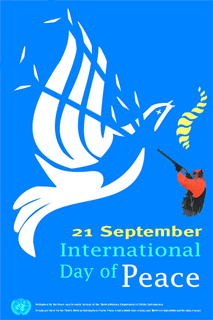
The Dove of Peace should never have let him have those last five beers.
(From an idea by alert reader Dan.)