Sometimes people just don’t surprise you

I almost feel bad writing this, but when Cheney shot a guy in the face, I actually wasn’t all that surprised.  It just didn’t seem all that far out of character.

Same thing when I heard that Karl Rove just might be lying to the grand jury.  Well, yes.  Obviously.

So now a Kennedy wrecks a sports car at a Capitol barricade, and his defense is that he was gorked out of his mind on pills.

Wow. 

If it works, Rove might want to try the same thing. 
 

Texas executed an innocent man

Common sense says it had to have happened at least once.  Well, it did:

A
man executed by the state of Texas in 2004 was convicted on an
erroneous interpretation of fire evidence, according to a report from
four leading arson experts.

[snip] 

“Each
and every one of the indicators relied upon have since been
scientifically proven to be invalid,” the Arson Review Committee report
states.

[snip]

John J. Lentini,
the former chairman of the forensic science committee of the
International Assn. of Arson Investigators, led the review panel and
said in an interview that he was convinced that Texas had executed an
innocent man.

One of the many ill-conceived
arguments pro-death penalty advocates use is that nobody had ever
proved that an innocent person was legally executed in the United
States.  Not anymore.

Fire is a truly complex and poorly-understood subject.  When I used to work at CSI,
we had a number of discussions about doing an arson case and really
digging into the relevant forensic examination techniques.  But we
never did, at least while I was there.  One big reason was that on
close scrutiny, most of the “techniques” amounted to little more than
unscientific guesswork, more a series of beliefs and habits than any
peer-reviewed analysis, really just one notch up from finding witches
with dunking chairs.  (The other reason we never did such an
episode — probably the main one, as I understand it — was that fire
is really super-hard and crazy expensive to shoot.)

It turns out
— big shock! — that fire behaves in unexpected ways.  Many of
the rules of thumb that arson investigators have used for many years
turn out to be complete crap. 

“Arson is the
only crime for which you can be executed based on the opinion of a man
with a high school education,” Lentini said, referring to the fact that
many arson investigators are qualified by judges as “experts” even
though they lack scientific training.

Back when
Chimpus Maximus was governor, you recall, he signed death warrants with
a bloodthirst unparalleled in modern U.S. history.  If somebody
out there has time to go through the cases looking for arson, there may
be some important history to correct.

Texas has the highest percentage in the country of people imprisoned on arson convictions.

Human
beings make mistakes.  So do judicial systems.  Capital
punishment inevitably involves the murder of a small number of innocent
people. 

Anyone who pretends otherwise is a liar.

Bush claims the right to ignore 750 laws

It’s a genuine ongoing constitutional crisis, and all too unreported.  Today’s Boston Globe article is a fine exception, building on a handful of earlier pieces (see here, here, here, and here for starters):

President Bush has quietly claimed the authority to disobey more
than 750 laws enacted since he took office, asserting that he has the
power to set aside any statute passed by Congress when it conflicts
with his interpretation of the Constitution.

[snip]

Legal scholars say the scope and aggression of Bush’s assertions that
he can bypass laws represent a concerted effort to expand his power at
the expense of Congress, upsetting the balance between the branches of
government.

[snip]

Phillip Cooper, a Portland State University law professor who has
studied the executive power claims Bush made during his first term,
said Bush and his legal team have spent the past five years quietly
working to concentrate ever more governmental power into the White
House. ”There is no question that this administration has been
involved in a very carefully thought-out, systematic process of
expanding presidential power at the expense of the other branches of
government,” Cooper said. ”This is really big, very expansive, and
very significant.” 

[snip]

… Bush is according himself the ultimate interpretation of the
Constitution. And he is quietly exercising that authority to a degree
that is unprecedented in US history.  

[snip]

The Constitution grants Congress the power to create armies, to
declare war, to make rules for captured enemies, and ”to make rules
for the government and regulation of the land and naval forces.” But,
citing his role as commander in chief, Bush says he can ignore any act
of Congress that seeks to regulate the military.

On at least four occasions while Bush has been president, Congress has
passed laws forbidding US troops from engaging in combat in Colombia,
where the US military is advising the government in its struggle
against narcotics-funded Marxist rebels.

After signing each bill, Bush declared in his signing statement that he
did not have to obey any of the Colombia restrictions because he is
commander in chief.

When Reagan ignored the explicit law of Congress and funded the Contras anyway, the result was a national scandal.  Bush does much more, repeatedly, and it’s barely even reported.

America, as we think of it, is in desperate trouble.  Even if you
don’t think Bush will take things further than, say, Gitmo, warrantless
spying, rendition for torture, etc., the precedent here is incredibly
dangerous for the future.

Bush has also said he can bypass laws requiring him to tell
Congress before diverting money from an authorized program in order to
start a secret operation, such as the ”black sites” where suspected
terrorists are secretly imprisoned.

Congress has also twice passed laws forbidding the military from using
intelligence that was not ”lawfully collected,” including any
information on Americans that was gathered in violation of the Fourth
Amendment’s protections against unreasonable searches.

Congress first passed this provision in August 2004, when Bush’s
warrantless domestic spying program was still a secret, and passed it
again after the program’s existence was disclosed in December 2005.

On both occasions, Bush declared in signing statements that only he, as
commander in chief, could decide whether such intelligence can be used
by the military. 

[snip]

Many laws Bush has asserted he can bypass involve requirements to
give information about government activity to congressional oversight
committees.

In December 2004, Congress passed an intelligence bill requiring the
Justice Department to tell them how often, and in what situations, the
FBI was using special national security wiretaps on US soil. The law
also required the Justice Department to give oversight committees
copies of administration memos outlining any new interpretations of
domestic-spying laws. And it contained 11 other requirements for
reports about such issues as civil liberties, security clearances,
border security, and counternarcotics efforts.

After signing the bill, Bush issued a signing statement saying he could withhold all the information sought by Congress. 

[snip]

David Golove, a New York University law professor who specializes
in executive-power issues, said Bush has cast a cloud over ”the whole
idea that there is a rule of law,” because no one can be certain of
which laws Bush thinks are valid and which he thinks he can ignore.

[snip] 

A president who ignores the court, backed by a Congress that is
unwilling to challenge him, Golove said, can make the Constitution
simply ”disappear.” 

Read the whole article.

Yes,
Clinton issued signing statements, too (a much smaller number, and not
proclaiming such vast new powers).  That doesn’t make it right.  (The
spectacle of right-wingers suddenly citing Clinton as an arbiter of
decency is truly brilliant.)

These are the facts: signing
statements were used only rarely until the Reagan administration. 
Since then, their use accelerated, creating a constitutional grey
area.  Bush is now exploiting and widening this loophole vastly more
often and more consistently to concentrate executive power than has
ever been tried. 

It’s not hyperbole to claim that Bush is
systematically arrogating to himself the powers of both Congress to
make law and the Supreme Court to interpret it, all while insisting
upon his power to use the military and intelligence agencies in any way
he personally sees fit. 

It’s all over his own signature. 

If you have the slightest grasp of history, you can see why this is terribly dangerous. 

Shame on anyone who dares support this assault on the Constitution while questioning the patriotism of others.

Keeping America safe from 5/4 time signatures

The people promoting the new Mission: Impossible III movie thought it would be cool to stick little electronic music devices in newspaper vending machines all over Los Angeles, rigged so that the movie’s theme would play when people opened the door.

Naturally, given just the slightest surprise in their daily lives, people freaked out.  Big time.  Pretty soon, the bomb squad was called in.  Well, obviously.  The logic is impeccable: Wires?  Music?  Aieee!  BOOM!

My tax dollars were just spent blowing up a musical newspaper rack.

Supposedly this was understandable, what with a box and wires being found in an unexpected place.  Yuh-huh.

But this “bomb”… was actually playing the Mission: Impossible theme.  Out loud.  Does anyone think Al-Qaeda would really do that?  Rig up bombs to play clich

Bush defines “democracy” for us

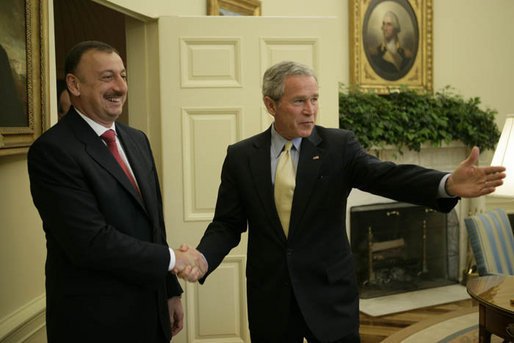
Here’s Bush describing Azerbaijan yesterday, according to the White House website:

[A] modern Muslim country that is able to
provide for its citizens, that understands that democracy is the wave of
the future.
 

Um… Ilham Aliyev’s government engages in arbitrary
imprisonment of political opponents, torture of persons in custody, and
government-wide corruption which prevents any real reform.  Just ask Amnesty, Human Rights Watch, or Bush’s own State Department, whose most recent report reads like a laundry list in Hell:

  • restricted right of citizens to peacefully change their government
  • torture and beating of persons in custody, leading to four deaths
  • arbitrary arrest and detention, particularly of political opponents
  • harsh and life-threatening prison conditions
  • police impunity
  • lengthy pretrial detention
  • pervasive corruption in the judiciary
  • some restrictions of privacy rights
  • periodic interference with media freedom
  • excessive use of force to disperse demonstrations
  • limited instances of violence and societal discrimination against women
  • trafficking in persons
  • limited workers’ rights

Read the U.S. government’s own report.  It’s terrifying.  No honest and/or sane person would call this “democracy.”

But Azerbaijan has oil.  And a bigass pipeline.  

So.

There’s Chimpus Maximus, just yesterday, welcoming this Saddam wannabe with open arms, saying he “understands that democracy is the wave of the future.” 

Bush has a truly interesting definition of the word “democracy.”

As you’ll see from clicking the links, Aliyev’s government also uses a variety of means to circumvent international
law, manipulate elections, and limit the media’s ability to report the
truth.

And
Aliyev only came to power in an election so filled with one-sided
irregularities than most objective observers considered it rigged.  (Even Bush’s own State Department dryly calls it “an election that did not meet international standards.”)

This is apparently what Bush means when he says Azerbaijan is developing as “a modern, secular, democratic country.”

We share the same
values.

Bush actually said.

Indeed.

(For other recent dictator love, see here, here, here, and here.  Or just click over to the growing collection.)